
Following in the footsteps of my mother, regarding her series of posts on The Great Lady Decorators, I thought I’d add Lucienne Day’s textile designs to the mix.
I was able to see the Art by the Yard exhibit right before it closed and visit the Textile Museum for the first time — what a gem in DC. Funny, I used to live in this neighborhood @ 20 years ago and never knew about this museum or Mitchell Park, since cleaned up for family activities.
Lucienne Day was an artist, textile designer, innovator and an entrepreneur in Mid Century Britain. She met her furniture designing husband, Robin Day (who’s chair design became standard ones used in stadiums and preschool), while studying together at The Royal Academy for the Arts. Much of the background regarding this exhibit and about her extraordinary life can be found on the exhibit site as well as my previous post, which cites other sources. I primarily wanted to follow up and reflect on some of her pieces that showcased the technological advances in textile design.
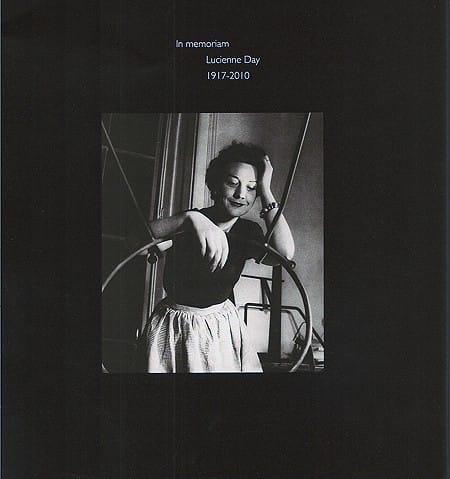
Firstly, I thought this photo of her is just stunning. It welcomed you as you entered the exhibit. Sadly, I learned that she just passed away this year, so the timing of this exhibit is a fitting tribute. (All photos courtesy of Art by the Yard, exhibition catalog.)
Here are some of her quotes and those from the exhibition that I found inspirational and really helped to explain her creative process:
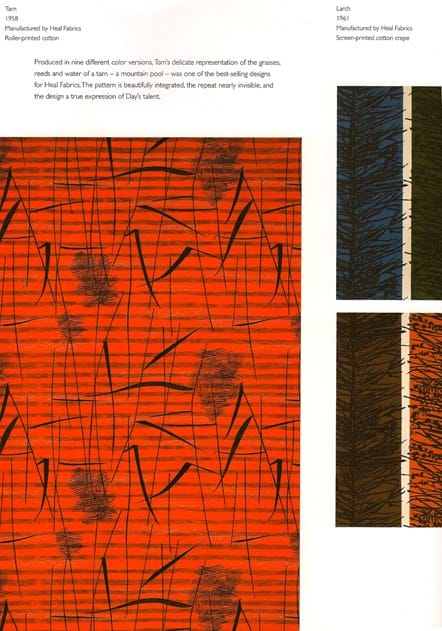
Her observation in 1957: [There is a] “definite move towards greater simplification and therefore more dignity and more attention to detail and to color relationships, less color in a single pattern, and above all for designs a more diffuse and textural nature where the repeat is cleverly disguised so that one is not immediately and consciously aware of it. This is largely, I think, where the skill of a good print designer lies.” Pattern is beautifully integrated and the repeat is nearly invisible and the design is a true expression of Day’s talent.
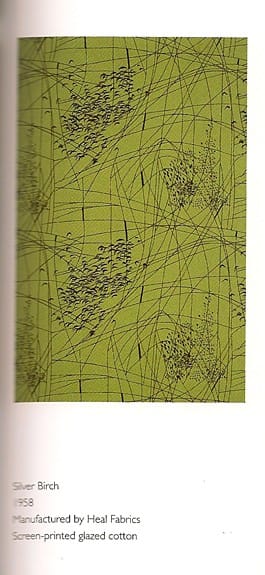
This must be why I was mesmerized by her Silver Birches design, which I learned about after I created our Birds & Birch wallcovering pattern. Ours is meant to be a linear, figurative take on stripes. Lucienne Day’s pattern is phenomenal in that I am still trying to learn how she did her repeat.

When I first started Casart Coverings, I was told that my designs could not be replicated onto wallpaper because there was no repeat. The challenge for us was to establish a repeat (a necessary component of wallpaper design to be able to continue the pattern) while maintaining a hand-painted, fluid look as in the original artwork. This was particularly important with our Colorwash wallpaper design because it wouldn’t work with a noticeable, visible repeat. This would have made it look unnatural, manufactured and contrived — not hand-painted — or badly painted. You don’t want to see edges or end points in good decorative painting and I wanted it to look to as if I had painted it directly on the wall. I think we pulled it off, as you can see here in an interior design that Mary Douglas Drysdale conceived to use with our wallcovering. We’d be interested to hear your feedback on this as well.

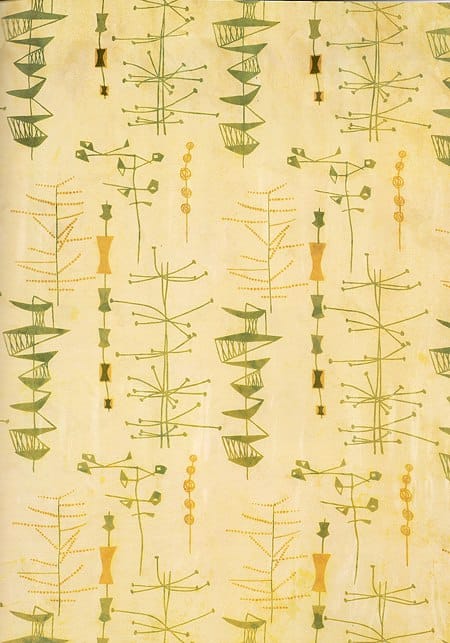
My favorite Lucienne Day design is her Climbing Trees (1953) which was printed on taffeta that has since faded beautifully over time. It was a gorgeous framed display about eight feet tall with perfect lighting that made it just glimmer. I think I liked this because of the combination of the design and the material on which it was printed.
Although I am more fond of some of her other patterns and colorways, not even mentioned in this post, I found Tarn (1958) to be another inventive example of “randomizing” the repeat.
A quote from Tom Worthington, the Managing Director of Heal Fabrics (1971), who printed her designs, describes the objective succinctly:
“Our aim is to try and provide as broad a choice as possible within our basic precept of modern printed designs, balancing geometrics and florals, large scale with small scale and avant-garde accepted modern ideas.”
This philosophy is why I think the concepts of many of her designs still work today and something that I hope to which Casart Coverings can continue to aspire.
— Ashley










Leave a Reply